Showing posts with label Marketo. Show all posts

Sunday, October 12, 2014

What’s Behind Hubspot’s IPO and Infusionsoft's $55 Million Financing?

by Dan Freeman 
Follow me on LinkedIn

Two huge events shook the world of marketing technology last week and demonstrated the continued determination to harness marketing data to improve marketing and sales processes.

On Monday, October 6th, Infusionsoft―makers  of marketing automation software serving the small business sector―announced a new $55 million round of funding headed by Bain Capital and Goldman Sachs.

Then on Thursday October 9th, Hubspot went public, raising $125 million in its flotation and becoming the 3rd marketing automation IPO. Eloqua went public in August 2012, raising $92 million, before it was promptly purchased by Oracle in December of that year for $811 million. Then in May of 2013, Marketo went public, raising nearly $80 million.

Infusionsoft's fourth round of financing caps a record year for VC funding in the marketing automation sector.

Below is a chart of selected VC financings for marketing automation related ventures.
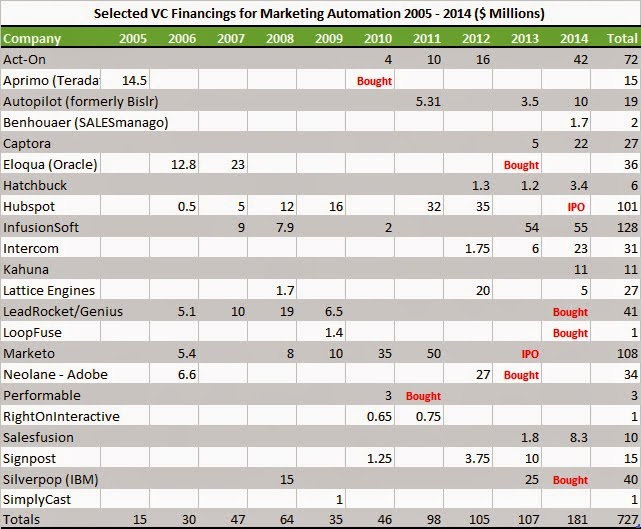


In addition to IPOs and venture funding, there’s also been a rash of acquisitions.


Between venture funding, IPOs and acquisitions, no one can argue that marketing automation is not hot.

But what’s behind this level of activity?

Advertising, and more generally marketing, has been in the throes of transformation for decades, or what the economist Joseph Schumpeter called ‘creative destruction’. To understand the transformation taking place, try to image marketing before Social Media, before Google, even before email and the Internet. Content was largely created by a few big ad agencies (think Don Draper) and pushed to consumers. Of course we still have ad agencies doing big TV campaigns but that’s far from the full story.  The Internet browser—Mosaic was the first—made content available to the masses and also spurred a content revolution.

With content vastly more accessible, a virtuous cycle of content creation and sharing was born. And it’s the exponential growth in content that is at the heart of the rise of marketing.  Google (and its predecessors) have transformed marketing from what was largely a top down, indiscriminate, push of content from a few large agencies, to a much more efficient, bottom up, pull from hundreds of millions of consumers via Internet search. That’s how Google has gone from start-up in 1998 to a $400 billion company in a mere 16 years. Of course we still push content, but at a fraction of the cost through Internet advertising and email marketing, and it’s aimed at intricate demographic and behavioral segments, and individuals that are far more likely to purchase.

The vast bulk of content today is created bottom-up, through websites, blogs, and, of course, social platforms. Add to the proliferation of content, the exponential growth in digital interactions, and now marketing has become more data intensive than Wall Street—hence the acquisition of marketing software firms by tech giants like IBM, Oracle, Microsoft and Adobe.

The transformation of marketing is represented both by meteoric rise in content and the ability of marketers to interact with that content. The primary challenge of marketing today—and the focus of many of today’s marketing technology firms—is managing the proliferation of content and interactions, and harnessing this data to put relevant content in the hands of customers and prospects so that products can sell themselves, or, in the case of B2B, at least do the bulk of the selling work before a hand-off to sales is made.

Software-as-a-Service (Saas), aka Cloud Computing

There’s another important factor at play in the rise of marketing; the coming of age of Software-as-a-Service (Saas) or cloud computing. SaaS made it far less costly to start new software ventures, and much cheaper (and less risky) for business users to purchase software. The IT department used to hold enormous sway over software investment dollars. Not so with cloud computing. The combination of vastly increased supply of software products and the release of purchasing power from IT to the marketing department resulted in rapid innovation and a burgeoning marketing for marketing technologies.

At the nexus of data, content, and technology is the sector known as Marketing Automation and it’s gone from red to white hot. Marketing Automation deals with functionality such as streamlining content creation, distributing across multiple channels, attracting web surfers, capturing leads, segmenting prospects, quantifying and responding to digital interactions, etc. To the extent that marketing technology firms can help marketers in this gargantuan effort, they will continue to thrive.


Thursday, September 11, 2014

Who’s Winning and Losing in Marketing Automation? Fall 2014 Round-up

by Dan Freeman 
Follow me on LinkedIn

One of the most important metrics in evaluating the ultimate value of any cloud software product is the customer retention rate, a number that encapsulates the value obtained versus client expectations. Retention rate takes into account usability, support, expectations set, and impact on marketing and/or revenue goals. Companies that receive value in excess of expectations generally renew; those that don’t opt out.

Download a Just Revised Marketing Automation Industry Report Covering Marketo, Eloqua, Pardot Act-On, Infusionsoft, Salesfusion and many others.

Though a valuable indicator for customers considering an investment in marketing automation, don’t expect marketing automation vendors to divulge much about retention. They sometimes publish the number and growth rate of their customer base but not a single one lets on to retention rate, or its inverse—churn.

Not to worry. Another class of marketing technology companies can shed light on the magic retention metric.

Software tracking company Datanyze scans over 18 million of the world’s most-trafficked websites, hunting for JavaScript embeds and web tags that indicate the presence of hosted software—in this case a marketing automation platform. The chart below shows the total number of websites using selected marketing automation platforms as of 9/1/14.


Note that websites do not equate with customers as a single customer may use marketing automation software on dozens or even hundreds of websites. Nevertheless, website count is a good indicator of success.

But not so fast...

It’s not just absolute website count but rather the changes—the additions and loses over time—that are the strongest indication of platform success in the marketplace.

I analyzed the top 20 firms for which we have data—and which fall roughly into the marketing automation space—and calculated the percent change in websites using their software since January 1, 2014.


Change happens quickly in dynamic markets. Demand for marketing automation software is growing overall but aggregates mask marketplace turbulence. According to the data, only two of the 20 firms—Pardot and Act-On—have increased their website count by more than ten percent since the beginning of 2014. Seven of the 20 platforms have actually lost websites, a few by over 20 percent.

The data also implies that churn is higher than many would believe. For the 20 marketing automation platforms, the aggregate ratio of websites adds to drops for the first eight months of 2014 was 1.08, meaning that for every 100 websites that added a marketing automation platform, 92 websites dropped one.

Note that the Datanyze metrics are an indication only only and are by no means a definitive measure of software presence. A few caveats of this data are in order and can be found here.

Great marketing can generate a steady stream of new customers in a growing market, but only positive customer experiences will result in high retention rates. Caveats aside, one thing is clear; rapid change is ahead in the marketing automation sector.

****   ****   ****    ****
Marketing Growth Strategies LLC has been engaged in research, analysis, lead generation, and client implementation in the Marketing Automation sector since 2009 and has recently revised its highly successful 2014 Marketing Automation eBook.

Considering implementing marketing automation? Download the 2014 Marketing Automation eBook


Wednesday, July 2, 2014

Marketing Automation Customer Retention Q2 2014

by Dan Freeman 
Follow me on LinkedIn

New numbers are out for changes in marketing automation platform usage, and in dynamic markets, things change quickly. Demand for marketing automation software is growing at a healthy clip, but aggregates can mask marketplace turbulence. Behind the 40 plus percent growth rate lies a multitude of customer experiences that determine the ultimate winners and losers.

As businesses struggle to get a handle on the new world of digital marketing, they experiment with new marketing platforms. Marketers try to master this software—to leverage its promise to generate more and better leads, and to streamline marketing processes. In highly competitive markets like marketing automation software, nuances in product features and ease-of-use can make all the difference. The way a new customer is on-boarded, the support or self-help tools provided, and even the reality of the customer experience versus the expectations set by vendors can have a major impact on retention.
Contact me now to create thought leadership--white papers, eBooks, webinars, newsletters--and a marketing strategy--to reach and engage with your best prospects
And in the Software-as-a-Service (SaaS) business model, retention is key. Vendors often lose money on new customers during the first year. It’s not until an annual renewal, or at least a period of several months, that customers become profitable. The most profitable customers are usually those with the longest tenure; they've ramped up usage and generally require less support.

Vendors tout their success with press releases about new customers and sometime even publish customer counts and growth rates. What’s not revealed are the dropped customers—the churn.

Until now, that is.

Working with the tech data sleuth firm, Datanyze, I looked at websites that added and dropped marketing automation software during the first six months of 2014. The results indicate that churn is higher than many would believe. For the top 11 marketing automation platforms, the ratio of websites adds to drops was 1.8, meaning that for every 9 websites that added a marketing automation platform, 5 website dropped one.

Tuesday, May 6, 2014

Who's Winning and Losing In Marketing Automation?

by Dan Freeman 
Follow on Twitter

Change happens quickly in dynamic markets. Demand for marketing automation software is growing at a healthy clip, but aggregates can mask marketplace turbulence. Behind the 40 plus percent growth rate lies a multitude of customer experiences that determine the ultimate winners and losers.

As businesses struggle to get a handle on the new world of digital marketing, they experiment with new marketing platforms. Marketers try to master this software—to leverage its promise to generate more and better leads, and to streamline marketing processes. For highly competitive products like marketing automation, nuances in product features, and how customers manage to utilize these features can make all the difference. The way a new customer is on-boarded, the support or self-help tools provided, and even the reality of the implementation experience versus the expectations set by vendors can have a major impact on customer retention.
Contact me now to create thought leadership--white papers, eBooks, webinars, newsletters--and a marketing strategy--to reach and engage with your best prospects
And in the Software-as-a-Service (SaaS) business model, retention is key. Vendors often lose money on new customers during the first year. It’s not until an annual renewal, or at least a period of several months, that customers become profitable. Vendors tout their success with press releases about new customers and sometime even publish customer counts and growth rates. What’s not revealed are the dropped customers—the churn.

Until now, that is.

Working with the tech data sleuth firm, Datanyze, I looked at websites that added and dropped marketing automation software from January through April of 2014. The results may surprise you. Salesforce's own marketing automation platform—Pardot—dominated the field with a net gain of 2,020 websites.

Thursday, April 10, 2014

Marketing Automation Industry to Reach $1.2 Billion

by Dan Freeman 
Follow on Twitter

We’ve updated our 2014 Marketing Automation eBook with a revised industry revenue estimate of $850 million for 2013 and a revised forecast of $1.2 billion for 2014. To arrive at these figures, we track over 30 marketing automation vendors, comparing user and revenue growth rates. We also profiled two additional marketing automation vendors. The new eBook explores all of the industry trends and profiles the leading vendors, including Marketo, Act-On, Pardot/Salesforce, Eloqua, InfusionSoft, eTrigue and many others.


****   ****   ****    ****
Marketing Growth Strategies LLC has been engaged in research, analysis, lead generation, and client implementation in the Marketing Automation sector since 2009 and has recently revised its highly successful 2014 Marketing Automation eBook.

Are you a marketing automation vendor? Learn about the capturing up to 500 fresh Marketing Automation leads.

Considering implementing marketing automation? Download the 2014 Marketing Automation eBook


Saturday, April 5, 2014

New Research on Top Marketing Automation Software Platforms

by Dan Freeman 
Follow on Twitter

Here are the latest marketing automation market share numbers for the Top 1 Million websites compiled by tech data firm Datanze: Hubspot – 21.1%, Marketo – 14.6%, InfusionSoft – 11.9% Eloqua – 9.9%, and Pardot – 8.0%.

But that's far from the full story.

Datanyze has just expanded its coverage of the Marketing Automation sector to include about 11 million websites in what they call the Datanyze Universe. I spoke with Datanyze Marketing VP Jon Hearty to delve more deeply into their data. The company looks the world's most authoritative websites—based on Alexa ranking—and analyzes the underlying source code to reveal software packages used on these sites.

Although 11 million is certainly a lot of websites to analyze, users should be aware that there are over 900 million websites (astounding number but here is my source). So even the Datanyze Universe represents just small fraction of total active sites.

Participate in our 2014 Marketing Automation eBook and reach thousands of new businesses looking for get a handle on digital marketing.   

Still, the data is revealing, as it tells us the actual number of found instances of each of the marketing automation software platforms among the universe of sites tracked. We all know that software companies have a way of, shall we say...embellishing their user base numbers. So this data represents a reality check on vendors' statements and marketing materials, and a touchstone for analysis.

We looked at the leaders in the marketing automation sector and how they changed as the list expanded from the Top 100K, to the Top Million, to the Datanyze Universe of 11 Million, and here is what we found.

Marketing Automation Leaders Among Alexa Top 100K Websites

Among the very largest websites, just over 3 percent had detectable marketing automation code—a notably low number. Among this group, Marketo is the clear leader, followed by Eloqua and Hubspot. It’s also interesting to note that Infusionsoft—designed for the entrepreneur and the very small business market—has a strong presence among the top 100K with a fifth place ranking.

Marketing Automation Software Ranking | MarketingTechReport

Marketing Automation Leaders Among Alexa Top Million Websites

Expanding the universe to the Alexa top 1 million sites, we see a different result. Although the top players remain almost unchanged (except VisiStat now joins the top 10, replacing VisualRevenue), Hubspot takes the lead, followed by Marketo and Infusionsoft.

Marketing Automation Leaders Among Datanyse Universe (11 Million sites)

Now we turn to the Datanyse Universe, which represents close to 11 million websites. Readers should note that, unlike the Top 100K or Top 1 Million websites tracked by Datanyse, the Datanyse Universe only approximates the top Alexa sites and includes many other sites that Datanyse customers have requested tracking on.

Want custom 3rd party White Papers, eBooks and Webinars to engage your prospects? Call or Email us now to discuss. 

Most striking is the jump of VisiStat from ninth place to first. VisiStat is not directly comparable to most of the 37 marketing automation vendors included in this data. The company has been in business for nine years and has a large customer base in both B2B and B2C. It’s primary functionality is the ability to identify previously anonymous website visitors through reverse DNS lookup, and to import visitor data directly into its database.


To play with the data yourselves, visit Datanyze

****   ****   ****    ****
Marketing Growth Strategies LLC has been engaged in research, analysis, lead generation, and client implementation in the Marketing Automation sector since 2009 and has recently revised its highly successful 2014 Marketing Automation eBook.

Are you a marketing automation vendor? Learn about the capturing up to 500 fresh Marketing Automation leads.

Considering implementing marketing automation? Download the 2014 Marketing Automation eBook


Saturday, December 21, 2013

Oracle to Buy Responsys for $1.5 Billion

by Dan Freeman 
Follow on Twitter

More evidence (as if we needed more) of the strength of the marketing automation sector came on Friday as Oracle announced the purchase of Responsys for about $1.5 billion.

Interestingly Responsys (MKTG +40.4%) closed Friday at $27.40, $0.40 above Oracle's (ORCL -0.6%) $27/share acquisition price. Speculation grew that investors are betting on an SAP counteroffer arriving soon.

Meanwhile, fellow cloud marketing automation software firms Marketo (MKTO +11.3%) and Constant Contact (CTCT +6.8%) closed up sharply.

As we’ve been saying for the past year, if you are a marketing automation company, this is your moment. Carp diem!
Gather ye rosebuds while ye may.
Old Time is still a-flying
And this same flower that smiles today,
Tomorrow will be dying.
****   ****   ****    ****

Marketing Growth Strategies LLC has been engaged in research, analysis, lead generation, and client implementation in the Marketing Automation sector since 2009 and has recently revised its highly successful 2014 Marketing Automation eBook.

Are you a marketing automation vendor? Learn about the capturing up to 500 fresh Marketing Automation leads.

Considering implementing marketing automation? Download the 2014 Marketing Automation eBook.